Why Does Time Appear to Slow When You’re in Free Fall?
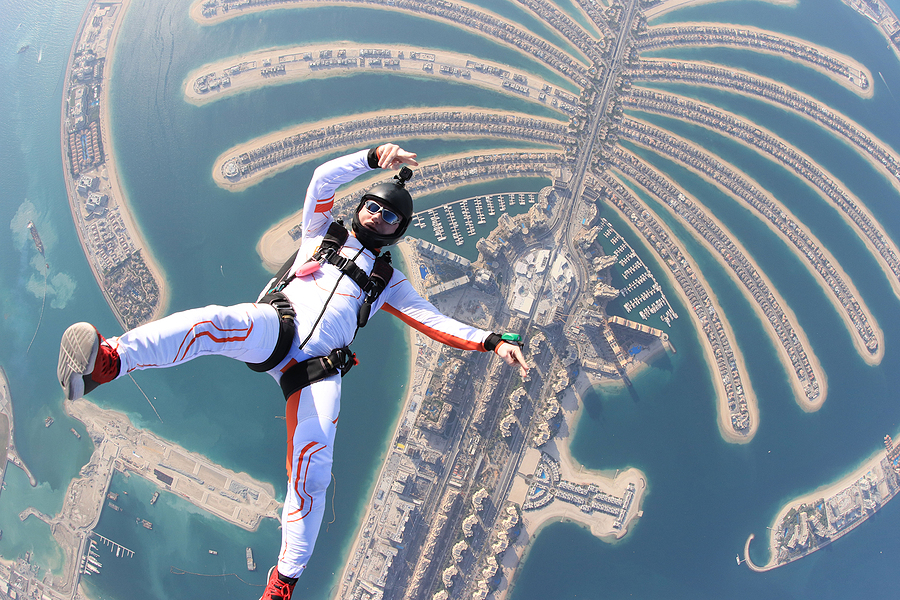
Few experiences are as exhilarating as the sensation of free fall. Whether skydiving from a plane, plunging from a cliff into water, or even imagining the concept in a physics classroom, free fall triggers a curious sense of altered time. Many people report that their perception of time stretches, making every second feel elongated. But why does time appear to slow when you are in free fall?
To answer this question, we need to explore both the physics of motion and the profound insights of Einstein’s theory of relativity.
Understanding Free Fall
Free fall occurs when an object is acted upon solely by gravity, with no other forces such as air resistance affecting its motion. Essentially, when a skydiver jumps from an aircraft before the parachute deploys, they are in free fall. During this period, gravity pulls the person downwards at an accelerating rate, approximately 9.8 metres per second squared on Earth.
While free fall is often discussed in terms of velocity and acceleration, it also raises deeper questions about time. Even though clocks tick normally in everyday life, the physics governing extreme conditions reveals that time is not as constant as it seems.
Time in Classical Physics
In Newtonian mechanics, time is absolute. Newton assumed that time flows uniformly for all observers, regardless of their motion or location in a gravitational field. According to this view, a person falling from a tall building and a person standing on the ground would experience the same passage of time. Classical physics cannot explain why free fall feels like it slows down time.
The discrepancy arises from perception rather than actual time dilation in Newtonian physics. The brain can process information differently under high-adrenaline conditions, making events appear slower. However, to understand genuine changes in the passage of time, we must turn to Einstein.
Einstein and the Relativity of Time
Albert Einstein revolutionised our understanding of time with his theory of relativity. According to general relativity, gravity is not merely a force but the curvature of spacetime caused by mass. Objects moving through this curved spacetime experience time differently depending on their position and speed.
A person in free fall is essentially following a path dictated by spacetime geometry. Surprisingly, general relativity predicts that a free-falling observer experiences less gravitational time dilation than someone stationary relative to a massive body. This means that while clocks near the Earth's surface tick slightly slower due to gravity, someone falling towards Earth feels that time passes normally in their frame of reference.
The Illusion of Slowed Time
If general relativity says a free-faller experiences time normally, why does it feel as though time slows? The answer lies in human perception and extreme experiences. When falling rapidly, sensory inputs flood the brain. The brain reacts to heightened danger by recording more memories per second, a phenomenon that stretches subjective time.
Studies of skydivers and people in high-stress scenarios suggest that the brain’s amygdala and hippocampus become more active under acute stress. These brain regions are responsible for processing fear and forming memories. When activity spikes, the brain perceives a longer duration for events, making a few seconds feel like minutes.
This is why even though your wristwatch shows that only seconds have passed, your mind feels as though the free fall lasts far longer. It is a powerful example of the difference between objective time, measured by clocks, and subjective time, shaped by human perception.
Connections With Physics Tuition
For students exploring these ideas in an A Level Physics tuition class, free fall provides an excellent example of how classical mechanics and relativity intersect. Many students first learn about acceleration and velocity in free fall and later discover that gravity also affects time itself. Teachers often use thought experiments involving falling elevators or orbiting satellites to illustrate gravitational time dilation and how it changes with position and speed.
Studying these concepts can be more than an academic exercise. They demonstrate that physics is not only about memorising equations but also about understanding the universe in ways that challenge intuition. Teachers guiding Physics tuition can show students how free fall relates to both Newtonian and Einsteinian frameworks, helping them build a holistic understanding of physics principles.
The Physics Behind Time Dilation
To quantify time dilation, physicists use the concept of proper time. Proper time is the time measured by a clock moving with the observer. For someone in free fall, proper time is calculated along their trajectory through curved spacetime. In contrast, a stationary observer experiences gravitational time dilation relative to the free-faller.
Near massive bodies like Earth, this effect is small but measurable. Highly precise atomic clocks can detect differences of nanoseconds between free-falling and stationary observers. While these differences are imperceptible in daily life, they are critical for systems like GPS, where satellites experience less gravity and thus tick faster than clocks on Earth. Engineers must account for this time dilation to maintain accurate positioning.
Experiencing Time Differently
Beyond equations and experiments, the phenomenon of slowed time in free fall teaches us about the intricate relationship between physics and human experience. The next time you watch a skydiver or feel yourself moving quickly, consider how your brain processes these moments. Even a short experience can feel monumental due to heightened awareness and memory formation.
This link between perception and physics is also an engaging way to introduce students to deeper scientific concepts. Discussing why time feels different during free fall can make physics lessons more relatable and memorable. It encourages curiosity about relativity and inspires students to explore how fundamental principles shape everyday experiences.
Free Fall in Popular Culture
Movies, documentaries, and extreme sports footage often exaggerate the sensation of slowed time in free fall. While the depiction is partly dramatized, it reflects real physiological responses to stress and adrenaline. Scientists studying high-speed scenarios, such as bungee jumping or skydiving, confirm that time perception changes during extreme experiences. This intersection of physics, biology, and psychology highlights how multidisciplinary the study of free fall can be.
Conclusion
Time appears to slow during free fall due to a combination of human perception and the subtle effects of relativity. While objective time may flow normally according to a free-falling observer, heightened awareness and memory processing make moments feel longer. From a physics perspective, free fall demonstrates both classical mechanics and Einsteinian relativity, offering valuable insights for students and enthusiasts alike.