Why E = mc² Is the Most Famous Equation in Physics
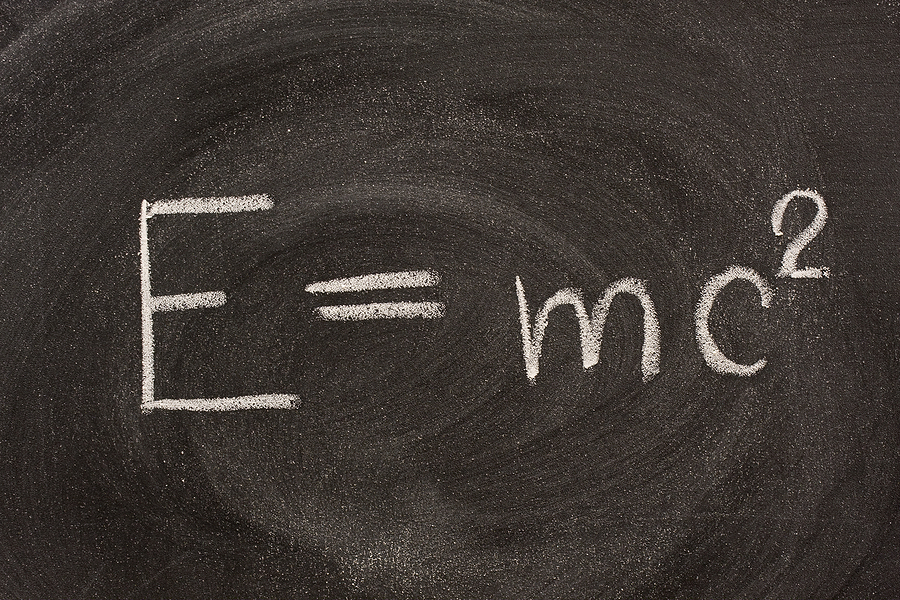
There are equations, and then there is E = mc². Most people cannot name a single mathematical formula, yet somehow this one has made it onto t-shirts, coffee mugs, and the walls of secondary school classrooms across the world. It is short, elegant, and carries an idea so staggering that it permanently changed how we understand the universe. But what does it actually mean, and why does it matter so much?
Let us break it down in plain English.
What the Letters Actually Mean
The equation has three parts:
- E stands for energy
- m stands for mass
- c stands for the speed of light (roughly 300,000 kilometres per second)
So the equation is simply saying: energy equals mass multiplied by the speed of light, squared. That is it. No complicated calculus, no pages of working out. Just three letters and a breathtaking idea hiding in plain sight.
The truly mind-bending part is what it implies: mass and energy are not two separate things. They are the same thing, just in different forms. A rock sitting on your desk has energy locked inside it purely by virtue of having mass. You cannot see it or feel it, but it is there.
Why the Speed of Light Changes Everything
Here is where things get interesting. The speed of light is already an enormous number: approximately 300,000,000 metres per second. When you square it, you get roughly 90,000,000,000,000,000. That is ninety quadrillion.
What this means is that even a tiny amount of mass contains a colossal amount of energy. A single paperclip, if its mass were entirely converted into energy, would release roughly the same energy as the atomic bomb dropped on Hiroshima. That is not an exaggeration. That is just the maths.
This is why the equation feels so dramatic. It tells us that ordinary, everyday matter is essentially concentrated energy on a scale that is almost impossible to imagine.
Where This Shows Up in Real Life
This is not just a theoretical curiosity. The equation has very real and very tangible applications.
Nuclear power is the most obvious example. Inside a nuclear reactor, uranium atoms are split apart in a process called fission. The products of that split have slightly less mass than the original atom, and that missing mass is converted directly into energy, exactly as the equation predicts. That energy heats water, drives turbines, and powers homes.
The sun works the same way, only through fusion rather than fission. The sun converts about four million tonnes of mass into pure energy every single second, keeping our solar system warm and alive. Without E = mc², we would have no explanation for why the sun shines.
Medical imaging also relies on this principle. PET scans, used in hospitals to detect cancer and monitor brain activity, depend on a process involving antimatter particles. When those particles collide with matter, they annihilate each other and produce energy. That energy is what creates the scan image. Einstein's equation is, quite literally, helping doctors save lives.
How It Connects to Learning Physics
For students working through complex topics in school, understanding E = mc² often feels like a distant goal, something reserved for university-level study. But the ideas it rests on, such as energy, mass, momentum, and the nature of light, are all introduced at A-Level, and getting a firm grip on them early makes a genuine difference.
This is one reason why good guidance matters so much. Whether you are preparing for your A-Level examinations or trying to build a stronger foundation, JC Physics tuition can help bridge the gap between surface-level memorisation and the kind of deep understanding that makes these ideas click. When a concept like mass-energy equivalence goes from feeling abstract to actually making sense, studying becomes far more rewarding.
Einstein's theory of relativity, from which this equation emerges, is a cornerstone of modern physics, and even a basic familiarity with its ideas gives students a richer perspective on the subject as a whole.
Why the Equation Became So Famous
Plenty of important equations never made it to the back of anyone's jacket. So why did this one?
Part of the answer is timing. When Albert Einstein published his special theory of relativity in 1905, the world was on the edge of enormous change. The equation eventually became associated with atomic energy, and with it, both the promise and the peril of science at its most powerful.
But the deeper reason is that the equation is genuinely surprising. Most of us walk through life treating matter and energy as completely different categories. Rocks are solid. Heat is invisible. They seem to have nothing in common. E = mc² says otherwise, and it says so in five characters. That combination of simplicity and shock is rare in any field, let alone physics.
It also tells a human story. Einstein was 26 years old, working as a patent clerk, with no university position and no laboratory. Yet in a single year he produced papers that reshaped physics entirely. There is something deeply compelling about that, and it has helped make both the man and his equation into cultural icons.
A Window Into Something Much Bigger
What makes E = mc² so enduring is not just its practical applications, remarkable as those are. It is that the equation opens a window onto a universe that is stranger, more connected, and more surprising than everyday experience suggests. Mass is not just mass. Energy is not just energy. At a deep level, they are the same thing wearing different clothes.
Physics is full of moments like this, where a simple formula quietly contains a revolution. The more you explore the subject, the more those moments appear.
Conclusion
If you are a student looking to build real confidence in Physics, whether you are tackling energy and mechanics or working towards your exams, Physics.com.sg offers dedicated Physics tuition designed to help you genuinely understand the subject, not just pass the test. Visit Physics.com.sg to find out more about their tuition programmes and take the next step in your Physics journey.