
(New tips are continually added to these pages. Check back in a few months' time for more)
TOPIC 5: Pressure
Tip 1:
Generally, the lower you go, the higher the pressure. The difference in pressure between 2 points is given by the equation p = hrg.
Therefore, a person on a beach will experience higher pressure than a person on top of an 800 m mountain. Another person who is scuba diving in the water at a depth of 50 m will experience higher pressure than the person on the beach.
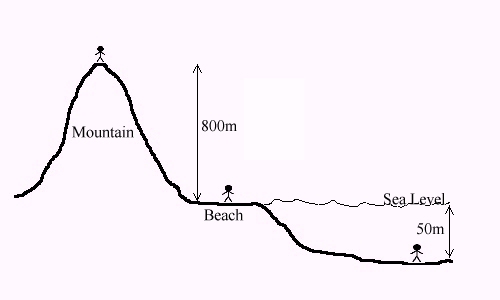
Assuming air to have a uniform density of 0.0013 g cm-3 and water a uniform density of 1 g cm-3, The calculations are as follows:
First, convert air density from 0.0013 g cm-3 to 1.3 kg m-3 and water density from 1 g cm-3 to 1000 kg m-3 (SI base units).
The difference in pressure between the person on the beach and the person on the mountain is:
p = hrg = 800 x 1.3 x 10 = 10,400 Pa
Since the person on the beach is at a lower position, his pressure is therefore higher than that experienced by the person on the mountain.
Atmospheric pressure is 101,000 Pa at sea level. Therefore, the person on the beach experiences 101,000 Pa whereas the person on the mountain experiences 101,000 - 10,400 = 90,600 Pa.
What is the pressure experienced by the scuba diver? Try the calculations yourself. You should get: 601,000 Pa (remember to use the density of water and not that of air).

© Copyright Physics.com.sg (Registration No. 52890077C). All rights reserved.
® First Class in Physics Tuition is the
Registered Trademark (TM No. T02/02149B) of Physics.com.sg
.