
(New tips are continually added to these pages. Check back in a few months' time for more)
TOPIC 12: Alternating Currents and Rectification
Tip 1:
How to find root-mean-square voltage or current? The procedure is to square the waveform first, then find the mean, then finally root the mean.
The r.m.s value of standard waveforms have to be memorised, eg.
Normal Sine/ Cosine Wave: Vrms = Vo/Ö2
Full-Wave Rectified Sine/Cosine Wave: Vrms = Vo/Ö 2
Half-Wave Rectified Sine/Cosine Wave: Vrms = Vo/ 2
Direct Current: Vrms = Vo
Square Wave with Max. at Vo and Min. at -Vo: Vrms = Vo
Pulse Train with Pulse Width W and Period T: Vrms = (Ö(W/T)Vo
For more complex waveforms, there are 2 methods to find the r.m.s.
Method 1 (Integration)
First, square the waveform. Then integrate the squared waveform to find the area under the graph. Next divide the integral by the period to find the mean. Finally, root the mean to get Vrms.
Method 2 (Cut-And-Paste Method or what I call the Ice Cream Method)
Let's use the normal sinusoidal waveform as our example (refer to animations below).
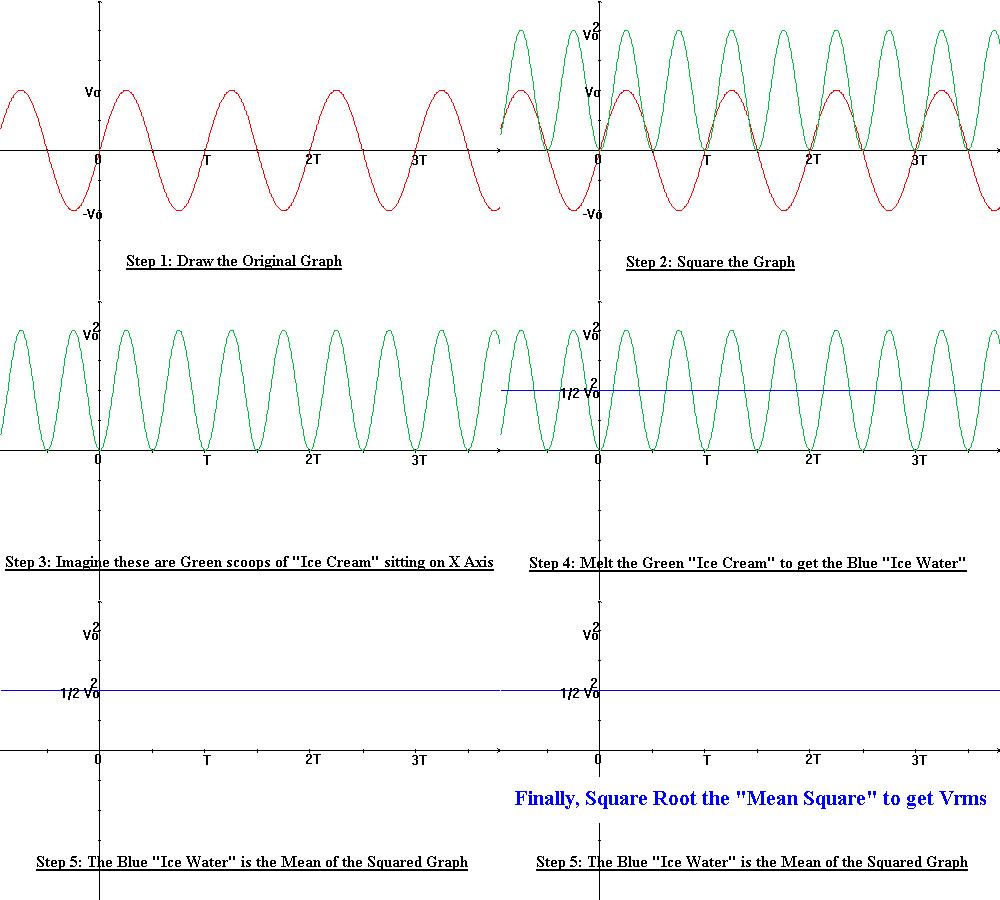
Step 1: Draw the original sinusoidal graph V = V0 sin wt (the Red one).
Step 2: Square this graph to get V2 = V02 sin2 w t (the Green one).
Step 3: Imagine that the green squared graph are scoops of ice cream resting on a tray (the tray is the X axis).
Step 4: Turn on the oven to melt the green ice creams so that they become ice water (the blue line).
Step 5: The blue line is the mean of the squared graph. In our example, the height of the ice cream is V02 so half the height (the mean) is V02/2.
Finally, root the mean (V02/2) to obtain V0/Ö2 (proven).
You can try with other waveforms, eg. full wave rectified, half wave rectified, triangular, square, or saw-tooth waves.

© Copyright Physics.com.sg (Registration No. 52890077C). All rights reserved.
® First Class in Physics Tuition is the
Registered Trademark (TM No. T02/02149B) of Physics.com.sg
.